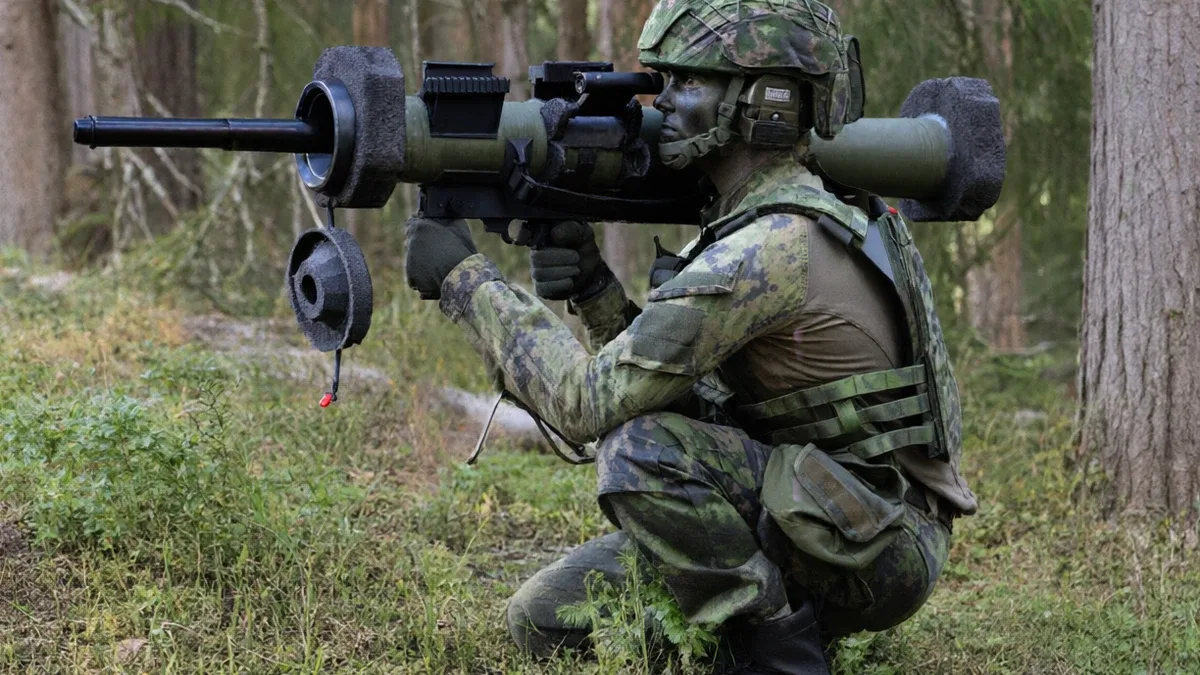
The Finnish Army announced today that it is procuring the RGW110 shoulder-fired anti-tank weapon from Dynamit Nobel Defence, along with associated training equipment, at a total value of approximately EUR 85 million (excluding VAT). Deliveries to the Finnish Army are scheduled to begin in 2027.
According to the Finnish Defence Forces, effective anti-tank capability requires several complementary systems — from mines and anti-tank weapons to missiles and drones — each fulfilling a different role. The heavy RGW110 serves as the close-range anti-tank weapon for every unit. The Finnish Army notes the weapon is jam-resistant and can be used independently of light and weather conditions across various operational environments, from urban centres to different terrain conditions, in both offensive and defensive operations. The relatively short range of non-guided munitions is offset by Finland's rugged, forested terrain.
The Finnish Defence Forces state they have followed main battle tank development for decades, with extensive research and test data available. Observations from Ukraine have confirmed earlier assessments of adversary armour. This information was used during the procurement process to compare systems and further develop capabilities. In Finland's assessment, anti-tank weapons must be able to penetrate a tank's armour and hit it within an appropriate tolerance, with a warhead capable of defeating reactive armour and a caliber large enough to transfer sufficient energy despite strong protection. Available systems were compared, and the system meeting the criteria was tested against a target with the corresponding armour value. The warhead was further developed with the manufacturer to ensure adequate performance.
The RGW110 family is the successor to the Panzerfaust 3, in service since the early 1990s. Hungary selected the new anti-tank weapon in 2022, in addition to Finland. Compared to the Panzerfaust 3, the RGW110 family features an advanced warhead offering greater flexibility, capable of destroying modern main battle tanks as well as structures such as building segments and field fortifications. The manufacturer states the RGW110 HH-T is more than 3 kg lighter than the Panzerfaust 3 and enables precise target engagement at ranges up to 600 m. A fire control sight can be mounted to increase hit probability.
According to an image released by the Finnish Army, Finland will introduce the RGW110 with a flip-up optic — reportedly with threefold magnification — allowing use without a fire control sight. A Picatinny rail aligned with the flip-up optic's sight line allows mounting of red dot sights, which in combination with night vision goggles could provide full night combat capability without additional clip-on night devices. Whether the Finnish Defence Forces will use this combination is not known.